


The Department of Electronics & Communication Engineering, Mangalore Institute of Technology & Engineering, organized an expert talk on “AI Beyond ChatGPT: Designing the Silicon that makes Modern AI Possible” on 19th August 2026. The session was organized to provide final-year students with an industry-oriented perspective on the hardware technologies that enable modern Artificial Intelligence systems. The final-year students from the Department of Electronics & Communication Engineering actively participated in the session, making it an informative platform for understanding the convergence of AI, semiconductor technology, and advanced digital systems.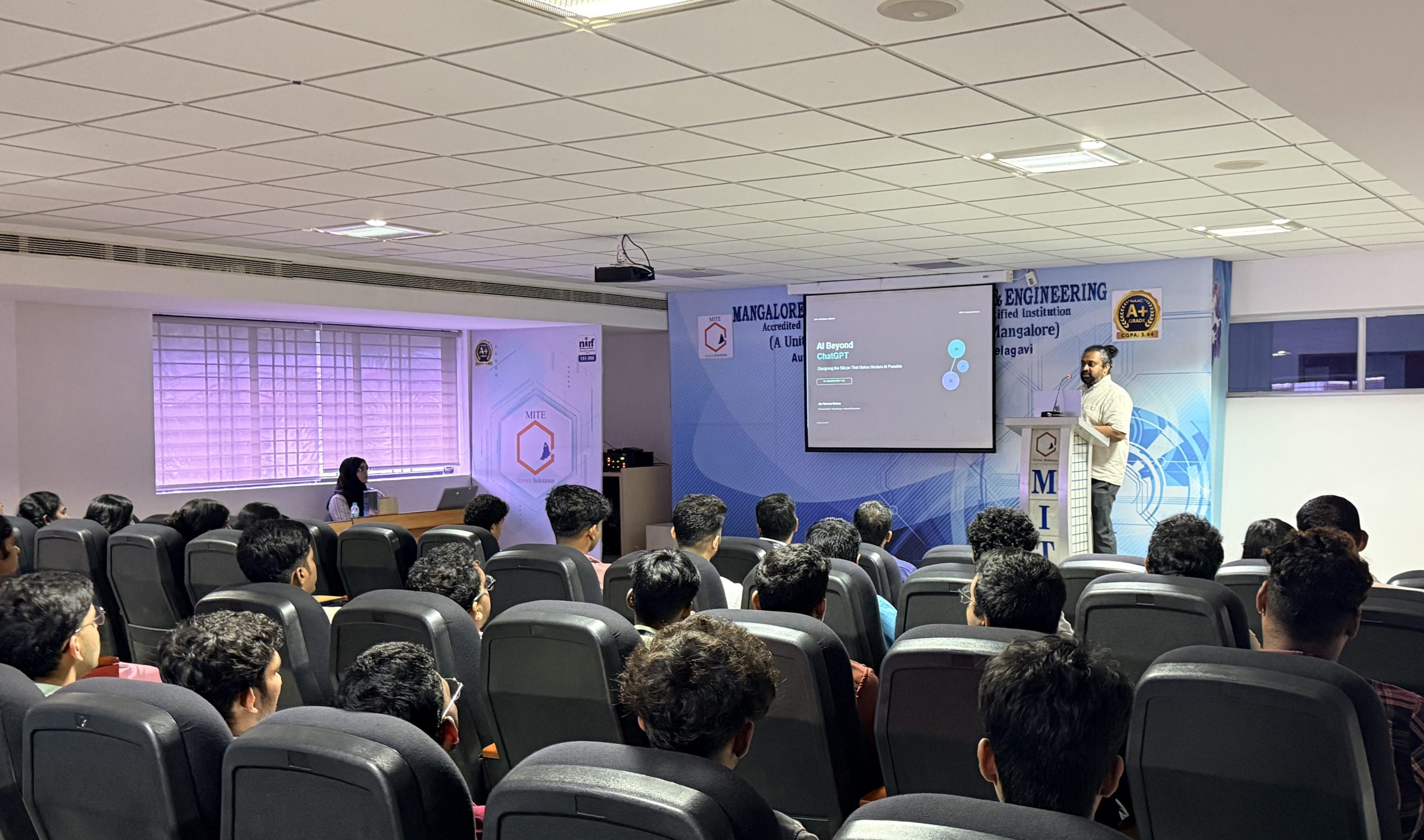
The resource person for the session was Mr. Jim Terence Colaço, an alumnus of MITE from the 2014 batch and currently working as Manager, ASIC Design R&D at Synopsys, Bengaluru. He is a semiconductor and chip-design professional with over 12 years of experience in the VLSI industry and also serves as the engineering owner for Synopsys’ PCIe subsystem offerings. Throughout his professional journey, he has worked across various aspects of complex chip development, gaining extensive experience in technical engineering and leadership. His areas of expertise include chip architecture, high-performance digital design, verification, and emerging technologies at the intersection of hardware and Artificial Intelligence. His professional journey from MITE to advanced semiconductor technology provided students with an inspiring example of how a strong engineering foundation can lead to opportunities in cutting-edge technology domains.
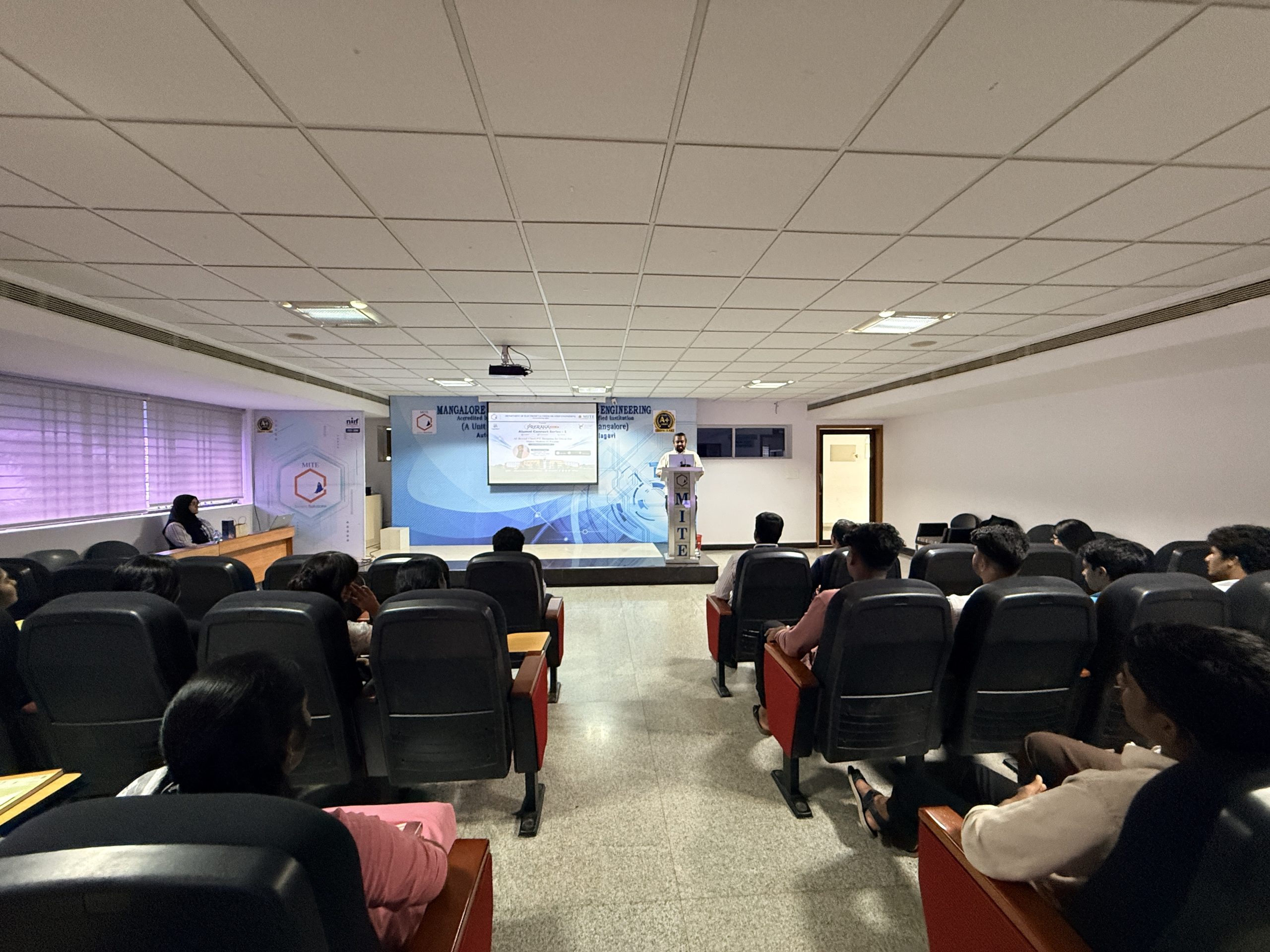 During the session, Mr. Jim provided students with an industry perspective on the hardware technologies behind modern AI, explaining how AI workloads are transformed into numerical operations and executed using specialized computing hardware. The talk covered several emerging concepts, including Transformer architecture, matrix multiplication, the evolution of CPU–GPU–NPU architectures, AI accelerators, systolic arrays, memory hierarchy, High Bandwidth Memory (HBM), KV cache, quantization, chiplets, AI clusters, and PPA optimization. The speaker also highlighted the growing role of Artificial Intelligence in chip design, RTL generation, verification, debugging, and Electronic Design Automation (EDA), while emphasizing the importance of engineering judgment, accuracy, and correctness in AI-assisted hardware development.
The session further encouraged students to strengthen their knowledge and skills in digital logic, computer architecture, machine learning, Python, RTL design, and verification, thereby preparing them for emerging opportunities in AI and semiconductor engineering. The talk concluded with an interactive Q&A session, during which students actively interacted with the resource person and clarified their queries regarding emerging technologies and career opportunities. The event was organized under the guidance of Dr. Vinayambika S Bhat, HoD, E&CE and Dean Quality Assurance, MITE and coordinated by Mr. Ranjith H D, Senior Assistant Professor, Department of Electronics & Communication Engineering. Overall, the expert talk provided valuable industry exposure and inspired students to explore the rapidly evolving intersection of Artificial Intelligence, semiconductor technology, and VLSI engineering.