


The Department of Robotics & Artificial Intelligence organized a two-day workshop titled “Additive Manufacturing and Process Optimization for Robotic Applications” on 9th and 10th December 2025. The workshop aimed at providing students with a strong foundation in additive manufacturing technologies and their applications in robotic system design and development. The workshop was conducted by Dr. Aveen K P, Assistant Professor, Robotics & Artificial Intelligence, MITE, and Dr. Adithya Hegde, Assistant Professor, Robotics & Artificial Intelligence, MITE. Both the resource persons possess strong academic and research backgrounds in the domains of additive manufacturing, advanced materials, and manufacturing processes.
 The two-day workshop introduced participants to the fundamentals of additive manufacturing, with a special emphasis on Fused Deposition Modelling (FDM) and its relevance to robotic applications. The sessions focused on understanding extrusion mechanics, material behaviour, layer bonding, and their influence on print quality and mechanical performance of printed components. Participants were trained to optimize slicing parameters such as layer height, infill density, build orientation, and support structures to improve print efficiency while reducing material wastage and fabrication time. The resource persons also discussed common printing defects and provided principle-based corrective measures to enhance print accuracy and reliability.
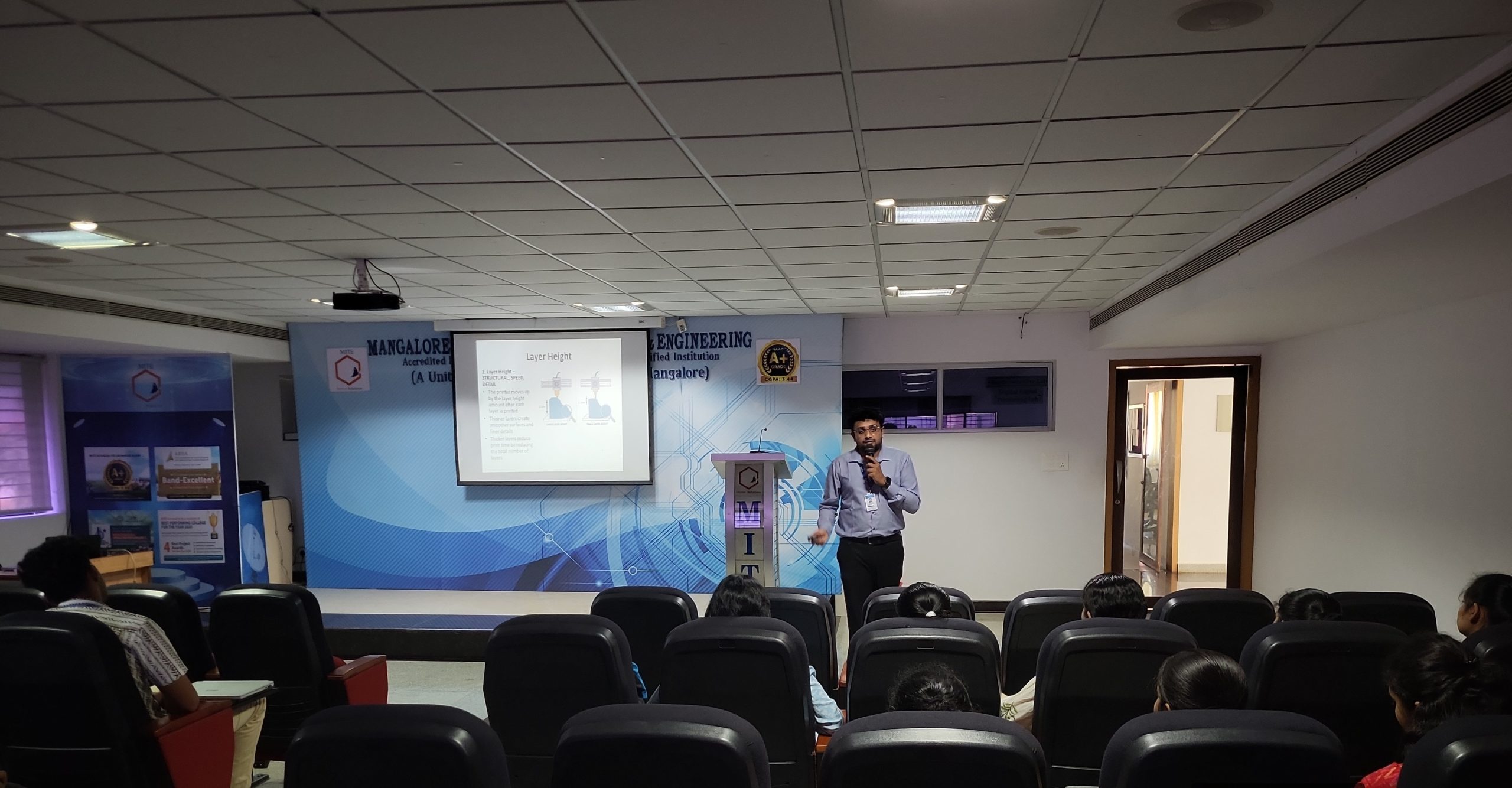 Hands-on sessions included parametric design of robotic components using Fusion 360, enabling students to develop FDM-ready designs suitable for real-world robotic applications. Simulation tools were introduced to validate designs prior to fabrication, helping participants understand the importance of virtual testing in modern manufacturing workflows. The workshop also highlighted the role of additive manufacturing in rapid prototyping, customization, and lightweight design for robotic systems. Through demonstrations and interactive discussions, students gained practical insights into how design optimization and process control can significantly improve the performance and durability of robotic components.
The sessions were highly interactive, combining expert lectures, live demonstrations, and practical design exercises. Students actively participated throughout the workshop and expressed that the program enhanced their understanding of additive manufacturing technologies and their application in robotics and automation. Overall, the two-day workshop was a great success and effectively bridged the gap between theoretical concepts and practical implementation, equipping students with industry-relevant skills in additive manufacturing and robotic design.