


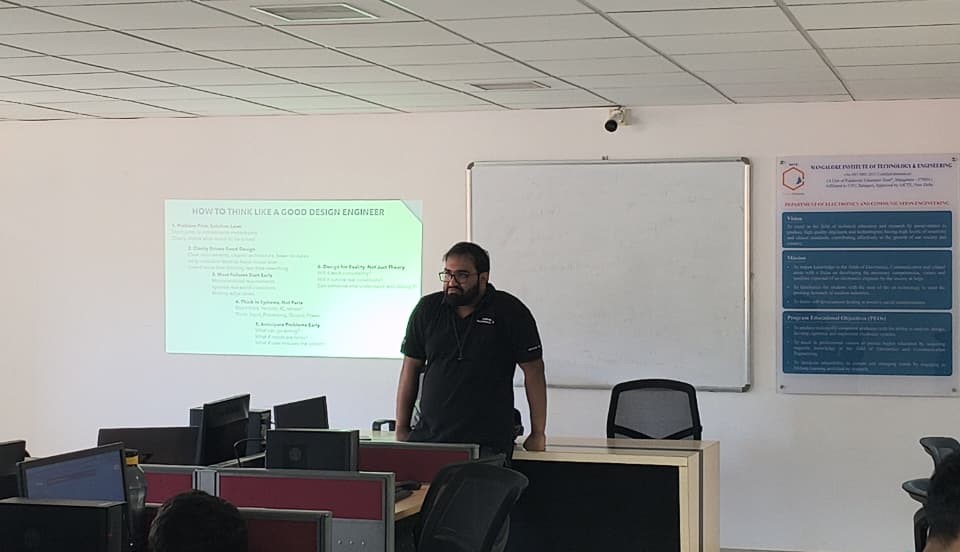
 The Department of Electronics & Communication Engineering, Mangalore Institute of Technology & Engineering, organized a two-day workshop on “Engineering Electronics by Design: Prototyping, Interfacing, and Debugging” on 06th and 07th April 2026. The workshop was designed to provide students with practical exposure to electronic system design and implementation. A total of 25 students actively participated in the program, making it an interactive and hands-on learning experience.
The resource person for the workshop was Mr. Floyd James Sequeira, Lead Electrical Hardware Design Engineer/Developer at Siemens Healthineers, Bengaluru. He is an experienced professional specializing in medical imaging systems, hardware architecture, system validation, and embedded electronics development. In his current role, he contributes to the design, testing, and validation of critical subsystems for advanced PET Patient Handling Systems (PHS) used in medical imaging platforms. Among his notable achievements is leading the complete electrical design, PLC programming, and commissioning of the Raven Eye Assembly Aid Fixture, successfully delivering a production-ready solution despite technical and vendor-related challenges. His strong industry background enabled him to provide valuable insights into practical implementation strategies and industry-oriented design approaches. He highlighted practical aspects of system design, validation, and implementation, and shared his experience in developing advanced subsystems for medical imaging platforms, along with real-world engineering challenges and solutions.
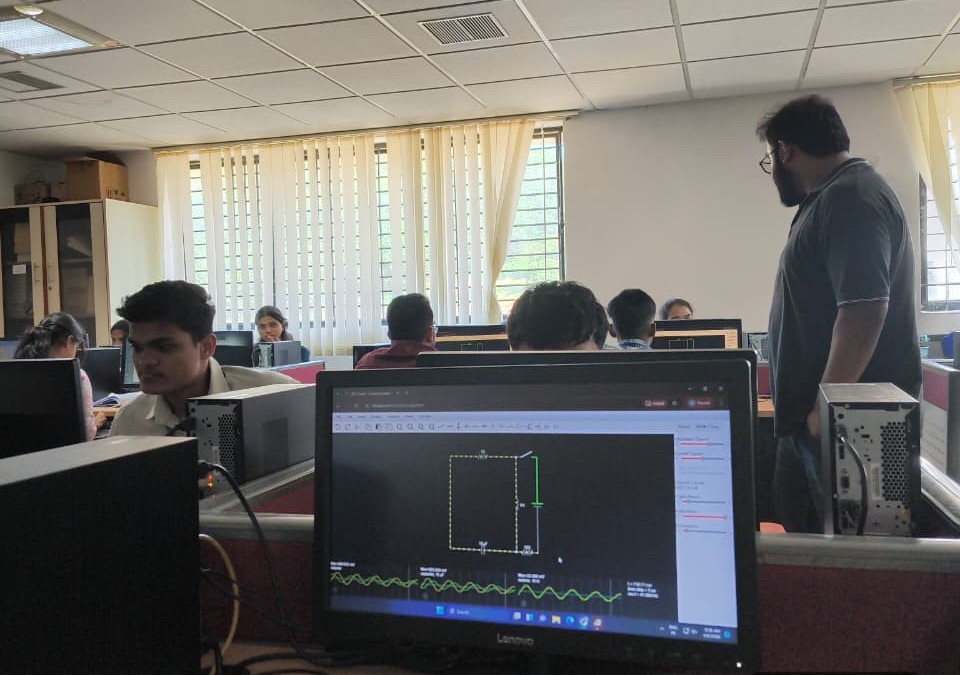 The workshop sessions focused on bridging the gap between theoretical concepts and practical applications through expert lectures, demonstrations, and hands-on activities. Participants gained exposure to circuit prototyping, waveform analysis, semiconductor device interfacing, sensor integration, and systematic debugging techniques. Emphasis was also placed on datasheet interpretation, design thinking, and requirement analysis, enabling students to develop a structured and problem-solving approach to engineering design. The interactive nature of the sessions, along with real-world problem statements, enhanced students’ confidence in handling hardware systems and improved their analytical and technical skills.
The event was coordinated by Mr. Divyesh Divakar and Ms. Vidya Dudhanikar, Assistant Professors, Department of Electronics & Communication Engineering. The workshop concluded successfully with active participation and engagement from students, serving as an effective platform for experiential learning and fostering industry-relevant skills in electronics design and development.