


The Department of Electronics & Communication Engineering of Mangalore Institute of Technology & Engineering (MITE) organized a two-day workshop titled “From Idea to Implementation: Skill Development in VLSI Design” on 13th and 14th October 2025, from 9:00 AM to 4:15 PM. The workshop was designed to provide students with an in-depth understanding of VLSI design principles, simulation tools, and multidisciplinary applications. It aimed to bridge the gap between theoretical learning and real-world implementation by offering both conceptual sessions and practical demonstrations on industry-relevant software tools.
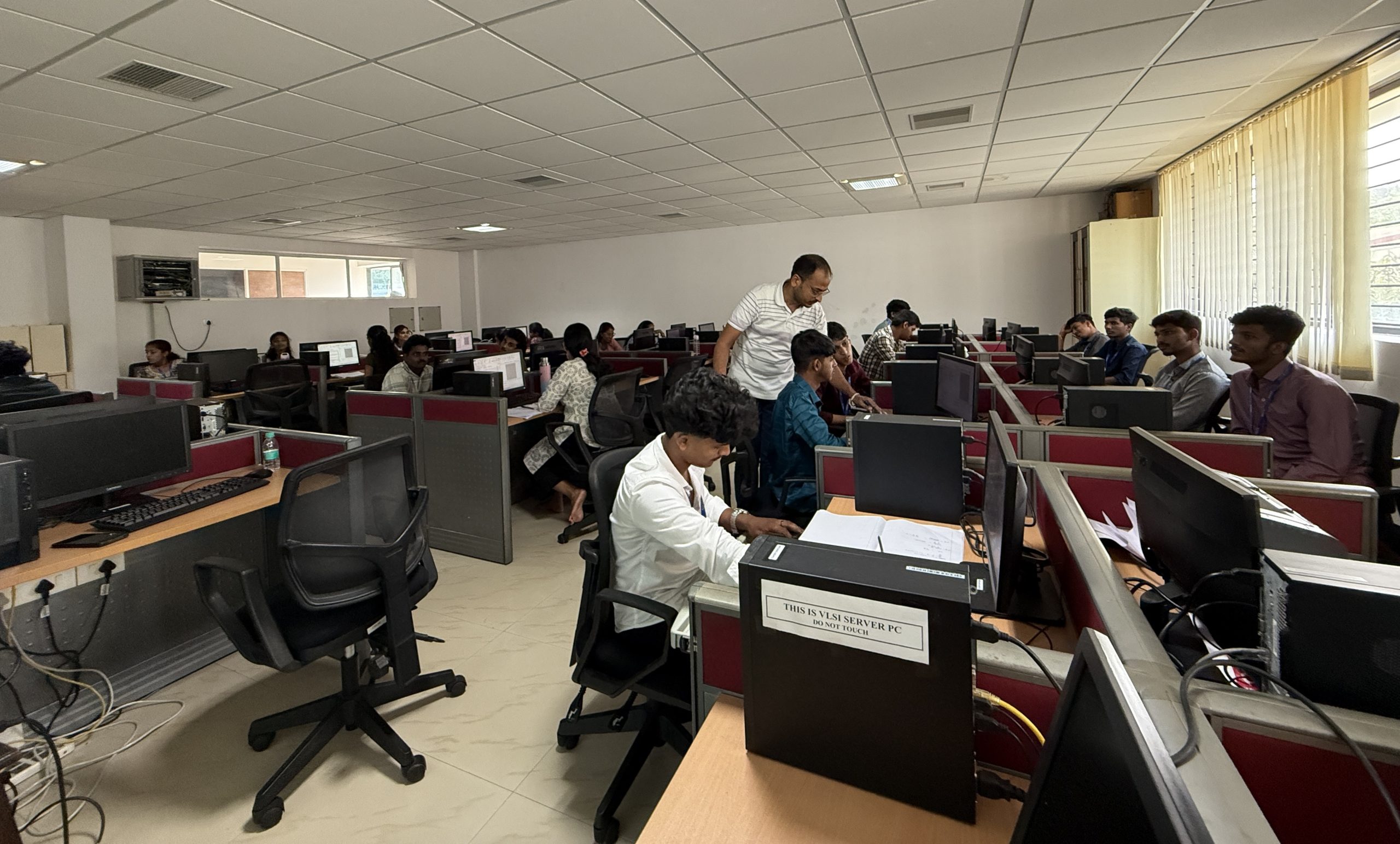 The sessions were conducted by Dr. Arjun Sunil Rao, Assistant Professor, Department of Electronics & Communication Engineering, Manipal Institute of Technology (MIT), and Dr. Amit Kumar Goyal, Assistant Professor, Department of Electronics & Communication Engineering, Manipal Institute of Technology (MIT).
Dr. Arjun Sunil Rao is an Assistant Professor in the Department of Electronics and Communication Engineering at Manipal Institute of Technology, MAHE, Manipal. He holds a Ph.D. in Fuel Cells and MEMS fabrication with significant research expertise in micro direct methanol fuel cells, VLSI design, and sensor development. He has collaborated with prestigious institutes such as IIT Bombay and TIFR, Mumbai, and has an impressive publication record in high-impact international journals. With three granted patents and multiple invited talks, Dr. Rao actively contributes to advancements in clean energy technologies, VLSI systems, and intellectual property awareness while mentoring students on innovative, research-driven projects.
Dr. Amit Kumar Goyal is an accomplished researcher and academician specializing in VLSI Design, Photonic Bandgap Devices, Photonic Spin Hall Effect, and Next-Generation Nanophotonic Devices for smart city and healthcare applications. He obtained his Ph.D. from the Academy of Scientific & Innovative Research (AcSIR), India, in Engineering Sciences. Dr. Goyal previously served as a Faculty at JIIT–Noida for 4.5 years and as a Postdoctoral Research Fellow at King Abdullah University of Science and Technology (KAUST), Saudi Arabia. He currently serves as an Assistant Professor (Senior Scale) at Manipal Institute of Technology, MAHE, where he continues to drive innovation in nanophotonic and integrated circuit design.
The first day of the workshop focused on “Fundamentals of VLSI Design and Circuit Simulation using LT Spice.” The participants were introduced to essential VLSI concepts, followed by a hands-on session using the LT Spice simulation tool. Through guided exercises, students simulated basic circuits, analysed their performance, and gained insight into analog design fundamentals. The afternoon session was centred on “Introduction to COMSOL Multiphysics and Design of Optical Filters,” where the resource persons demonstrated how COMSOL can be applied for optical and photonic design. The session concluded with a productive Q&A segment, encouraging interaction and project-based discussions.
On the second day, participants explored the simulation of advanced physical phenomena and the integration of multiple physics modules within COMSOL. The session emphasized the importance of multidisciplinary design and its applications in the domains of MEMS and nanotechnology. The afternoon session introduced “VLSI Layout Design using Microwind Software.” Students were given hands-on experience with IC layout design methodologies, CMOS fabrication processes, and layout implementation. This interactive session helped participants understand theoretical design rules and their practical realization in integrated circuit layouts.
A total of 30 second-year students from the Department of Electronics & Communication Engineering actively participated in the workshop. The event was coordinated by Mr. Ranjith H D, Senior Assistant Professor, and Ms. Sahana G. Kundar, Assistant Professor, Department of Electronics & Communication Engineering, MITE, Moodabidri. Their effective coordination ensured smooth conduct of the workshop, integrating both technical rigor and interactive learning.
The key takeaways from the workshop included enhanced technical knowledge of VLSI design workflows, improved understanding of simulation tools such as LT Spice, COMSOL Multiphysics, and Microwind, and strengthened problem-solving and analytical skills. Students gained practical exposure to industry-standard design processes, fostering an appreciation for innovation and research in electronics and semiconductor design. The workshop served as an excellent platform for skill development, motivating participants to pursue further learning and research in the field of VLSI, MEMS, and nanotechnology.
